











The intersection of contemporary art, fashion, and athletic heritage took center stage in London during Frieze Week, as multidisciplinary Spanish artist Coco Capitán partnered with Dazed and Adidas Originals for an immersive exhibition celebrating the iconic Stan Smith sneaker. Staged within the bustling creative ecosystem of the British capital, the collaboration served as a high-profile exploration of the shoe as a versatile canvas for self-expression. By merging her signature text-led practice with recycled materials and the unmistakable tone of archival sports culture, Capitán produced a bespoke series of artworks designed to challenge how audiences perceive originality, creative friction, and the conceptual weight of the written word.
The exhibition invited guests to navigate a specially curated venue space where Capitán’s sharp, minimalist aphorisms were integrated directly into the physical architecture. Drawing from a diverse portfolio that spans photography, painting, writing, and large-scale installation, the artist utilized the commission to bridge the psychological parallels between high-performance athletics and the artistic process. The resulting works—crafted from disused nautical sails and anchored by the unmistakable "Stan Smith green" palette—offered a tangible reflection of how foundational sportswear continues to influence modern creative culture.
Background Context of the Event and Frieze Week Integration
Frieze London remains one of the most significant fixtures on the international contemporary art calendar, drawing collectors, curators, and cultural commentators from across the globe to the British capital each October. In recent years, the perimeter of the official art fair has expanded into a city-wide festival of brand activations, pop-up exhibitions, and cross-disciplinary collaborations, with fashion houses and athletic labels increasingly seeking to embed themselves within the fine art dialogue.
Adidas Originals chose this high-visibility window to reinforce the cultural equity of the Stan Smith, a silhouette originally introduced in the 1960s as a leather tennis shoe that has since transitioned into an omnipresent lifestyle staple. By aligning the shoe with Capitán’s text-driven artistic ethos, the brand aimed to pivot away from straightforward commercial product placement and instead foster an intellectual engagement with creativity. The collaboration tapped into London’s unique positioning as a global hub where heritage design intersects with avant-garde contemporary art movements, making it an ideal backdrop for a project exploring the boundaries of personal expression.
Chronology of the Creative Process
The genesis of the project followed a structured trajectory typical of Capitán’s methodical approach to multidisciplinary art-making. The timeline of the collaboration began months prior to Frieze Week, moving from initial conceptual briefings to material sourcing, iterative sketching, and final installation.
Phase one involved conceptual research, during which Capitán analyzed the historical intersections between sport and creativity. Focusing on the mental resilience required by professional tennis players—particularly on the iconic grass courts of Wimbledon—she sought to distill the psychological pressures of competition into universal themes of self-belief and originality.

Phase two centered on material selection and prototyping. Eschewing traditional, pristine artist canvases, Capitán opted for reclaimed, disused nautical sails. These textured, weathered surfaces provided a historical foundation for the works, contrasting sharply with the minimalist, modern typography overlaid upon them. Rather than relying on an intuitive color palette, the artist worked strictly within the visual parameters defined by Adidas, utilizing the classic Stan Smith green to unify the series.
Phase three comprised the physical realization of the exhibition space during Frieze Week. Treating the venue layout as a deliberate choreography, Capitán engineered the visitor pathway to control the pacing and delivery of her textual narratives. Every placement decision—from spatial intervals to lighting and scale—was meticulously calculated to maximize viewer retention and engagement in a high-distraction environment.
Artistic Philosophy and the Mechanics of Minimalism
At the core of Capitán’s practice is an interrogation of how language functions across different mediums. Whether executing photographic series or large-scale installations, her work is defined by a rigorous stripping away of decorative excess.
"Writing is the beginning of pretty much all of my projects," Capitán explains, detailing a daily discipline that requires her to fill a set number of notebook pages regardless of inspiration. "Thoughts and ideas often come to one’s mind in the form of words… The dull thoughts are often the ones that turn out to be useful once I manage to discover the underlying themes or patterns within them."
When transitioning these notebook musings onto physical canvases, Capitán employs a distinctly minimalist philosophy. In an era saturated with digital stimuli and fragmented user attention spans, she views audience attention as a finite and highly valuable commodity. Consequently, her aphorisms are deliberately concise, avoiding subjective adjectives and ornamental flourishes in favor of direct, universally resonant statements.
"I’m looking to leave an impression in the mind of my reader," she notes. "I don’t want to steal a single second in the process of transporting an idea from my mind to someone else’s, so I use resources such as colour, spacing and texture to insist on the concept at hand, so the message can be decoded easily and promptly."
Supporting Data and Industry Observations
The collaboration reflects broader commercial and cultural trends within the luxury and sportswear sectors, where brands increasingly leverage fine art credentials to elevate mass-market products. Industry analyses indicate that experiential marketing campaigns tied to major art weeks yield significantly higher consumer engagement and brand sentiment than traditional advertising formats, particularly among millennial and Gen Z demographics who value cultural authenticity.
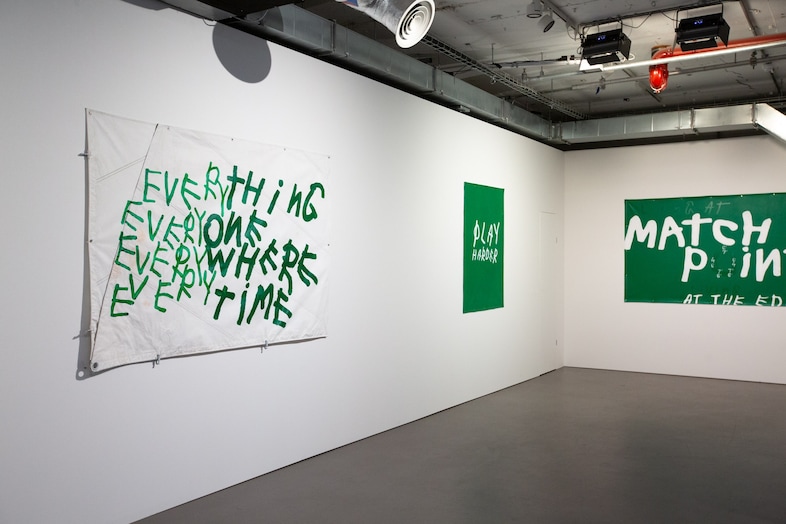
Furthermore, the emphasis on sustainability—exemplified by Capitán’s choice of recycled nautical sails rather than virgin textiles—highlights a growing corporate imperative to incorporate circular economy principles into artistic collaborations. By repurposing industrial waste as a primary medium, the project aligned with concurrent consumer demands for environmentally conscious production methods within the fashion and art industries.
The Conceptual Core: Resisting the First Idea
The central narrative threaded throughout Capitán’s exhibition text addresses the psychological trap of creative inflexibility—specifically, the tendency for creators to fall prematurely in love with their initial concepts.
"I find it easy to fall in love with one’s first idea," Capitán observes. "What I am trying to say with this artwork is that falling in love with your first idea and following it blindly may prevent you from contemplating other ideas and solutions that you may love just as much as the first one. By all means, love all of your ideas, but be flexible and generous in the process of thinking: if the first idea fails despite you being enamoured with it, don’t forget there will be a next idea to fall in love with."
This thesis served as a meta-commentary on both the design process behind the Stan Smith and the broader realities of commercial artistic production. In an economic climate that pressures creators for rapid output and immediate commercial viability, Capitán’s message champions the necessity of iterative failure and intellectual patience.
Broader Impact and Implications
The partnership between Coco Capitán, Dazed, and Adidas Originals during Frieze London underscores the enduring viability of art-brand integrations when executed with conceptual depth. By grounding a commercial footwear icon within a rigorous, text-based fine art framework, the project successfully transcended standard promotional tropes.
As brands continue to seek refuge from digital ad fatigue through physical, immersive experiences, collaborations of this scale demonstrate that thoughtful curation and material integrity can elevate consumer products into genuine cultural artifacts. For Capitán, the project reaffirmed the universal applicability of her minimalist ethos, proving that whether inscribed on a notebook page, a reclaimed sail, or a tennis shoe, the written word remains one of the most potent catalysts for human introspection.