






The horological landscape has undergone a significant shift in recent years, moving away from a singular obsession with mainstream luxury icons toward an appreciation for the esoteric, unconventional designs of the mid-20th century. Capitalizing on this trend, Nivada Grenchen has officially launched the Autochron Mecaquartz, a model that bridges the gap between the brand’s storied 1970s archives and contemporary accessibility. By transitioning from the high-cost, high-profile automatic movements of its previous revivals to a high-performance mecaquartz platform, the brand has effectively democratized a design language once reserved for high-end collectors.
A Chronology of the Autochron Revival
The trajectory of the Autochron began in earnest in 2024, when Nivada Grenchen introduced a faithful, automatic-powered recreation of its historical Chronosport models. These earlier releases were lauded by purists for their adherence to original dimensions and mechanical complexity, specifically utilizing the Valjoux 7750 movement. However, the inherent physical constraints of the 7750—notably its thickness—often resulted in a case profile measuring approximately 15.7mm.

Following the success of the 2024 launch, the company identified a market demand for a more versatile, daily-wearable interpretation of the aesthetic. Throughout 2025 and early 2026, development shifted toward refining the ergonomics of the case. By transitioning to a mecaquartz movement, engineers were able to shave 3mm from the case depth, resulting in a streamlined 12.7mm profile. This shift represents a calculated strategic move by the brand to offer the aesthetic appeal of a boutique vintage chronograph at a price point significantly below that of its mechanical counterparts.
Technical Specifications and Engineering Shifts
The core of this evolution lies in the integration of the Seiko VK67 mecaquartz movement. Unlike standard quartz calibers, the VK67 employs a mechanical module for the chronograph functions, providing the tactile feedback and sweeping motion associated with traditional horology.
- Case Dimensions: 38mm diameter; 12.7mm thickness.
- Water Resistance: 200 meters, achieved via a screw-down pillbox crown and robust case construction.
- Movement: Seiko VK67, offering +/- 20 seconds per month accuracy and a three-year battery life.
- Bezel: 120-click unidirectional ratcheting bezel, an upgrade from the bidirectional friction-fit bezels seen on previous iterations.
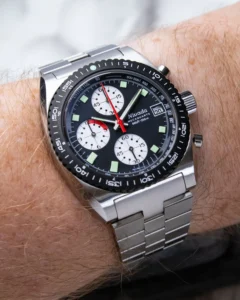
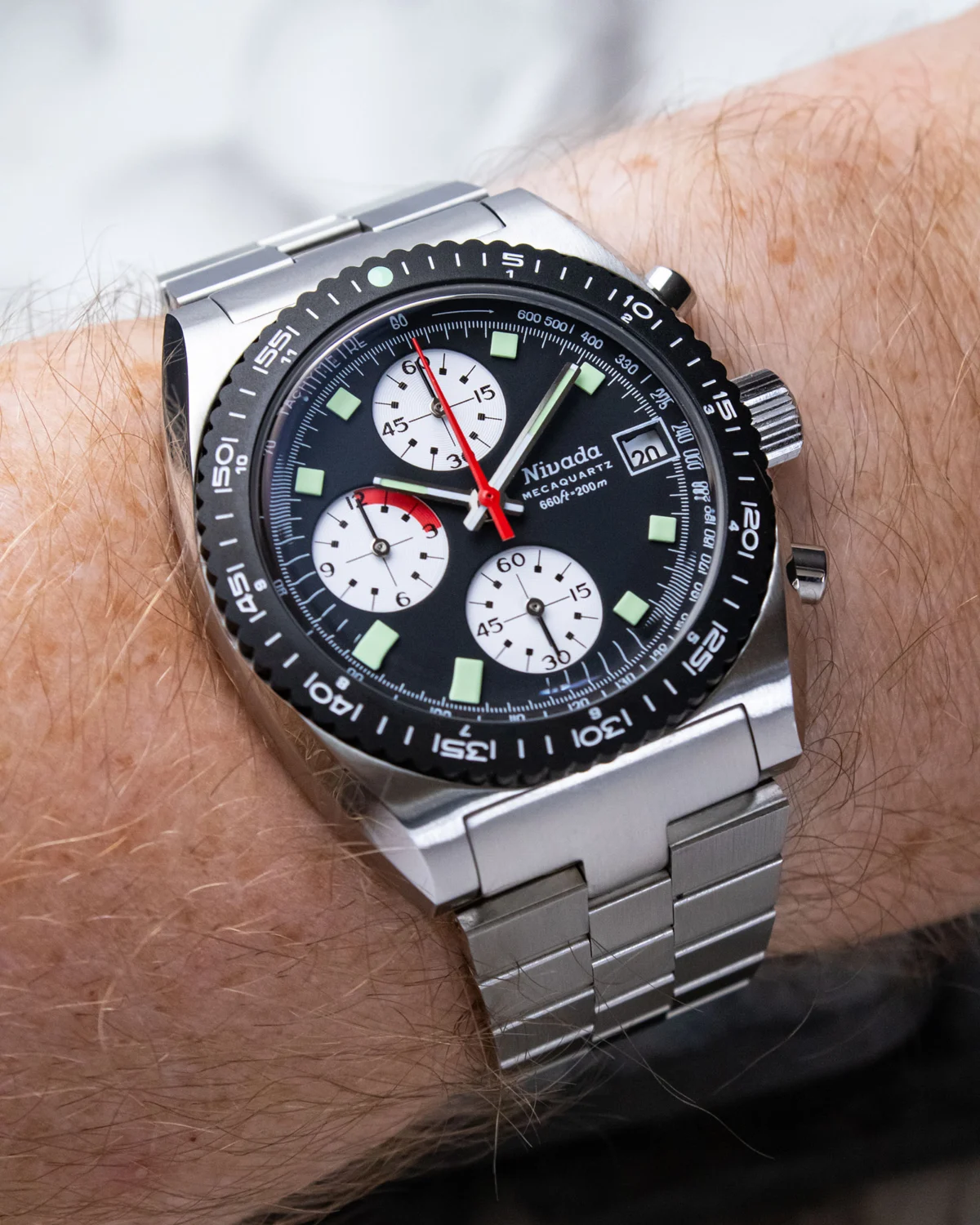
The reduction in height is achieved primarily through the use of a more modest box sapphire crystal and a re-engineered, slimmer caseback. Despite the loss of the automatic rotor, the watch retains a "muscular" stance, characterized by broad-shouldered lugs and a high-quality, fully milled stainless steel bracelet. The bracelet itself features solid-link construction and screw-fastened pins, marking a departure from the hollow-link styles common in the 1970s and ensuring modern durability.

Design Philosophy and Aesthetic Evolution
The Autochron Mecaquartz displays a clear departure from the experimental, asymmetric dial layouts seen in the 2024 Chronosport. The new model utilizes a balanced 6-9-12 subdial configuration, which resonates with the broader consumer preference for symmetry and clarity.
Designers at Nivada Grenchen have implemented a tiered approach to the dial’s visual identity. The reverse panda configuration, for instance, features mint-green square lume plots, while other variants utilize traditional batons or updated versions of the brand’s signature "birthday candle" indices. The inclusion of a red accent stripe on the 9 o’clock subdial serves as both a functional indicator—timing the first three hours of a cycle—and a stylistic nod to the bold, high-contrast graphics that defined the racing chronographs of the 1970s.
Market Context and Economic Implications
The launch of the Autochron Mecaquartz at an MSRP of $730 USD positions Nivada Grenchen within a highly competitive segment of the market. Historically, the brand has functioned as a "heritage re-issue" specialist. By utilizing the VK67, the brand is able to bypass the high labor and material costs associated with the Valjoux 7750, which often pushes similar models into the $2,000+ price bracket.

Industry analysts observe that this strategy is increasingly common among boutique firms looking to capture the "entry-level enthusiast" demographic. By offering a piece that maintains the brand’s identity while lowering the barrier to entry, Nivada Grenchen is effectively broadening its reach. This approach acknowledges that while many collectors value mechanical heritage, a significant portion of the market prioritizes wearability, accuracy, and the "vintage look" over the internal movement technology.
Official Stance and Future Outlook
While Nivada Grenchen has not released specific sales projections, the decision to refine the case profile suggests a long-term commitment to the Autochron line. The brand’s messaging emphasizes the "all-purpose" nature of the watch, highlighting its 200-meter water resistance as a differentiating factor from the strictly "desk-diver" chronographs that populate the current market.
The reception from the enthusiast community has been mixed but largely positive, with debates centered on the use of quartz technology versus the benefit of a thinner, more wearable case. However, in the context of a wider horological market that is currently cooling off after the speculative bubbles of 2021-2022, the move toward value-driven, high-quality, and reliable timepieces appears to be a defensive and sustainable posture.

The Broader Impact on Vintage-Inspired Design
The success of this model will likely serve as a bellwether for other brands currently mining their archives. The shift toward "functional nostalgia"—where the exterior honors the past while the interior embraces modern, practical engineering—is becoming the industry standard.
The Autochron Mecaquartz is not intended to replace the mechanical Chronosport; rather, it is designed to exist alongside it as a daily-wear alternative. This dual-track production strategy allows Nivada Grenchen to maintain its reputation for heritage-grade instruments while simultaneously building a commercial volume through more accessible, mass-market-friendly designs. As the brand continues to expand its presence through authorized dealers, the focus remains on the synthesis of 1970s "funk" and 21st-century manufacturing precision, ensuring that the legacy of the original Autochron continues to influence modern collections.
For the average collector, the implication is clear: the era of needing to spend thousands of dollars to acquire a watch with authentic vintage design cues and robust, modern build quality is effectively coming to an end. By prioritizing form factor and daily utility, Nivada Grenchen has secured a place in the current market for those who appreciate the aesthetic of the past but demand the reliability of the present.