





The final day of London Fashion Week Spring/Summer 2027 delivered one of the most talked-about and culturally provocative runway spectacles in recent fashion history. While the British Fashion Council calendar still held the marquee presentation for heritage house Burberry later in the evening, earlier slots showcased a dynamic array of contemporary talent. Collections from established innovators and emerging names—including Selasi, Tolu Coker, Central Saint Martins newcomer Liza Keane, and Greek conceptual designer Di Petsa—dominated the industry discourse.
Among these presentations, it was Di Petsa’s runway show that captured global attention, courtesy of a jaw-dropping, viral finale featuring pop star Leigh-Anne Pinnock. The performance piece immediately seized digital media attention, cementing the designer’s reputation for orchestrating high-impact, boundary-pushing moments designed to provoke conversation and transcend traditional fashion boundaries.
The Viral Finale of Holy Milk
Staged as the culmination of a collection explicitly titled Holy Milk, the runway presentation reached its emotional and visual climax when former Little Mix member Leigh-Anne Pinnock stepped onto the catwalk. Pinnock, visibly pregnant, modeled a Grecian-inspired, draped two-piece garment that celebrated maternity.
As she reached the midpoint of the runway, Pinnock came to a halt, surrounded by a circle of crouching models. In a surreal and unscripted-feeling performance that instantly flooded social media platforms, milk began to spurt from her breasts. Turning on the spot as the liquid poured, she anointed the models positioned below her. The visceral display left the front row and press pit stunned, perfectly encapsulating the raw, elemental themes of the designer’s latest offering.
Industry analysts noted that the stunt demonstrated a masterclass in modern fashion marketing. In an era where digital engagement dictates the commercial success of a runway presentation, Di Petsa successfully bridged high conceptual art with viral social media currency. Within hours of the show’s conclusion, hashtags associated with the designer and Pinnock trended globally, generating millions of impressions across Instagram, TikTok, and X (formerly Twitter).
Chronology of London Fashion Week SS27
The Spring/Summer 2027 showcase in the British capital unfolded over five intensive days of scheduled exhibitions, digital presentations, and off-schedule happenings. The timeline of events leading up to the grand finale reflects the diverse creative output driving contemporary British fashion:
- Day One and Two: The schedule commenced with foundational London mainstays, highlighting structural tailoring and sustainable innovations. Emerging voices utilized experimental textiles to address climate concerns within garment manufacturing.
- Day Three: Focus shifted toward narrative-driven design. Presentations by Tolu Coker emphasized community, cultural heritage, and ethical labor practices, drawing praise from fashion critics and sustainability watchdogs alike.
- Day Four: Selasi and newcomer Liza Keane brought avant-garde perspectives to the forefront. Keane, drawing on psychological frameworks such as Carl Jung’s shadow work, presented minimalist yet deeply symbolic garments that explored the subconscious.
- Day Five (The Finale): The final day began with high-concept presentations before culminating in Di Petsa’s midday runway show. The schedule concluded with the traditional evening showcase from Burberry, sealing another successful chapter for the British Fashion Council.
Exploring the Theme of Motherhood
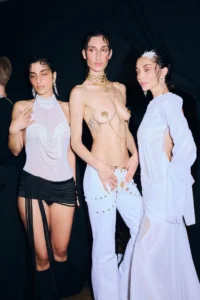
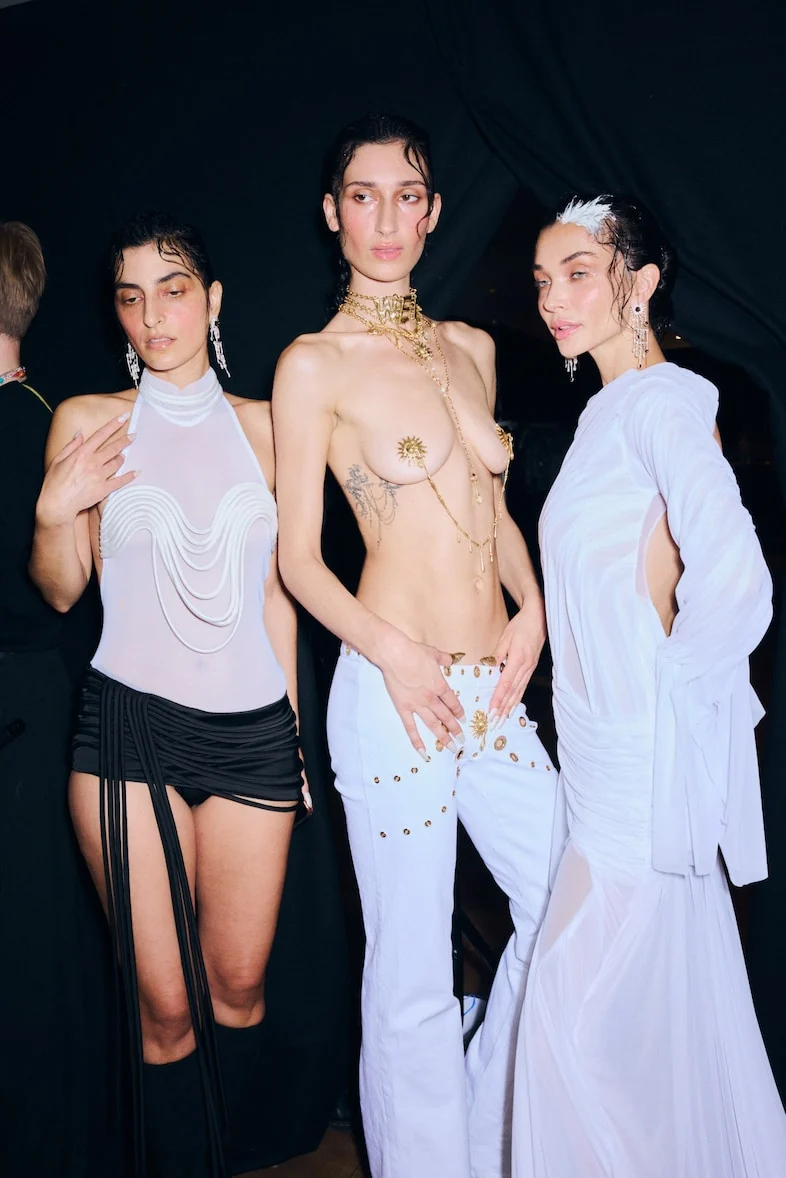
Beyond the viral shock value of the finale, Di Petsa’s SS27 collection was underpinned by a deeply philosophical exploration of motherhood in all its forms. Known for her signature wet-look aesthetic—achieved through intricate draping and specialized fabrics that mimic water—the designer expanded her material vocabulary to explore gestation, birth, and maternal bonds.
The casting choices reflected this thematic depth. Two models walked the runway carrying real-life infants, seamlessly integrating the realities of early parenthood into the high-fashion environment. In another poignant moment, a model paused mid-walk to kiss her partner, who was holding their child in the front row.
The runway also featured a diverse age range of models, including a mature female model accompanied by a younger male model, evoking a mother-son dynamic. Later in the presentation, another couple walked hand in hand before engaging in a passionate embrace directly in front of the photographers’ pit, serving as a visceral reminder of the human lifecycle that precedes parenthood.
Artistic Intent and Designer Statements
Di Petsa, whose legal name is Dimitra Petsa, does not currently have children of her own. However, she noted that her lack of personal maternal experience allowed her to approach the subject from a more universal, abstract perspective.
"We are pregnant with our own self," Petsa explained in a post-show statement detailing the conceptual underpinnings of the collection. "We give birth to different versions of ourselves when we grow too large inside us to be hidden and then again will be reborn."
This philosophical framework recontextualizes the physical acts of lactation, pregnancy, and nurturing not merely as biological processes tied to raising offspring, but as psychological milestones of personal evolution. By framing personal growth through the metaphor of pregnancy, the designer invited audiences to reflect on their own internal transformations and periods of rebirth.
Broader Impact and Industry Implications
The integration of provocative performance art into London Fashion Week SS27 underscores a broader shift in how designers communicate complex socio-cultural narratives. Over the past several seasons, Di Petsa has consistently pushed the boundaries of traditional runway norms. Previous seasons included high-profile moments such as casting media personality Mia Khalifa and instructing models to kiss front-row attendees, choices that blurred the lines between observer and participant.
Fashion historians and cultural commentators have observed that such spectacles serve a dual purpose. Creatively, they offer designers an unmediated channel to express political and philosophical viewpoints regarding bodily autonomy, gender, and fertility. Commercially, they provide emerging and independent labels—who often lack the multi-million-dollar advertising budgets of heritage luxury houses—with the visibility required to compete on a global scale.
The reaction from the fashion community has been largely positive, with critics praising the collection’s emotional resonance and technical execution. The draped silhouettes, constructed from fabrics that appeared damp or fluid, successfully married the brand’s established aesthetic signatures with the new thematic focus on bodily fluids and maternity.
As London Fashion Week SS27 draws to a close, Di Petsa’s Holy Milk collection will likely be remembered as the defining aesthetic moment of the season. By tackling subjects historically sidelined or sanitized in polite society—such as lactation and the physical realities of pregnancy—the designer has once again challenged the industry to expand its definition of beauty and relevance. Whether future collections will maintain this level of theatricality remains to be seen, but the industry waits with palpable anticipation to see what the conceptual visionary will produce next.