








The intersection of artificial intelligence and retail apparel has long been romanticized in popular culture, most famously captured in the 1995 cult-classic film Clueless, where protagonist Cher Horowitz seamlessly coordinates outfits using an automated, computerized wardrobe. For decades, this futuristic concept remained confined to Hollywood storytelling. However, rapid advancements in generative artificial intelligence, computer vision, and machine learning are transforming this cinematic trope into commercial reality. At the forefront of this evolution is Alta, a pioneering fashion technology company founded by Jenny Wang, which is redefining how consumers curate closets, conceptualize outfits, and interact with digital retail environments.
The Genesis and Growth of Alta
Founded with the vision of digitizing personal style, Alta officially launched its consumer-facing application in 2023, offering users the ability to construct comprehensive digital replicas of their physical closets. By leveraging advanced AI, the platform empowers individuals to generate personalized virtual avatars that accurately reflect their physical measurements and likeness. Users can subsequently mix, match, and virtually try on garments, transforming everyday wardrobe management into an interactive, digital experience.
The company’s trajectory accelerated significantly following a successful $11 million funding round held last year. Led by venture capital firm Menlo Ventures, the financing attracted a diverse array of high-profile strategic investors, including supermodels Jasmine Tookes and Karlie Kloss, Rent the Runway co-founder Jenny Fleiss, and the Anthology Fund, the venture capital arm of AI research firm Anthropic. This influx of capital provided Alta with the resources necessary to scale its infrastructure, expand its engineering talent pool, and forge strategic alliances across the fashion landscape.
Since its public debut, adoption metrics for the platform have scaled rapidly. According to company disclosures, users have generated more than 100 million unique outfits on the platform. The application’s innovative approach has not gone unnoticed by mainstream media; esteemed publications such as Time and Vogue recognized Alta as one of the top technological innovations of the previous year. Furthermore, the platform has established official partnerships with major industry stakeholders, including resale marketplace Poshmark and the Council of Fashion Designers of America (CFDA), with additional collaborations slated for announcement in the near future.
Pioneering Brand Integration: The Public School New York Collaboration
While Alta initially gained traction as a standalone consumer application, the company’s strategic focus has increasingly pivoted toward enterprise solutions. Specifically, Alta is building robust application programming interface (API) integrations and website widgets designed to allow brands to natively embed virtual try-on technology directly into their own e-commerce platforms.
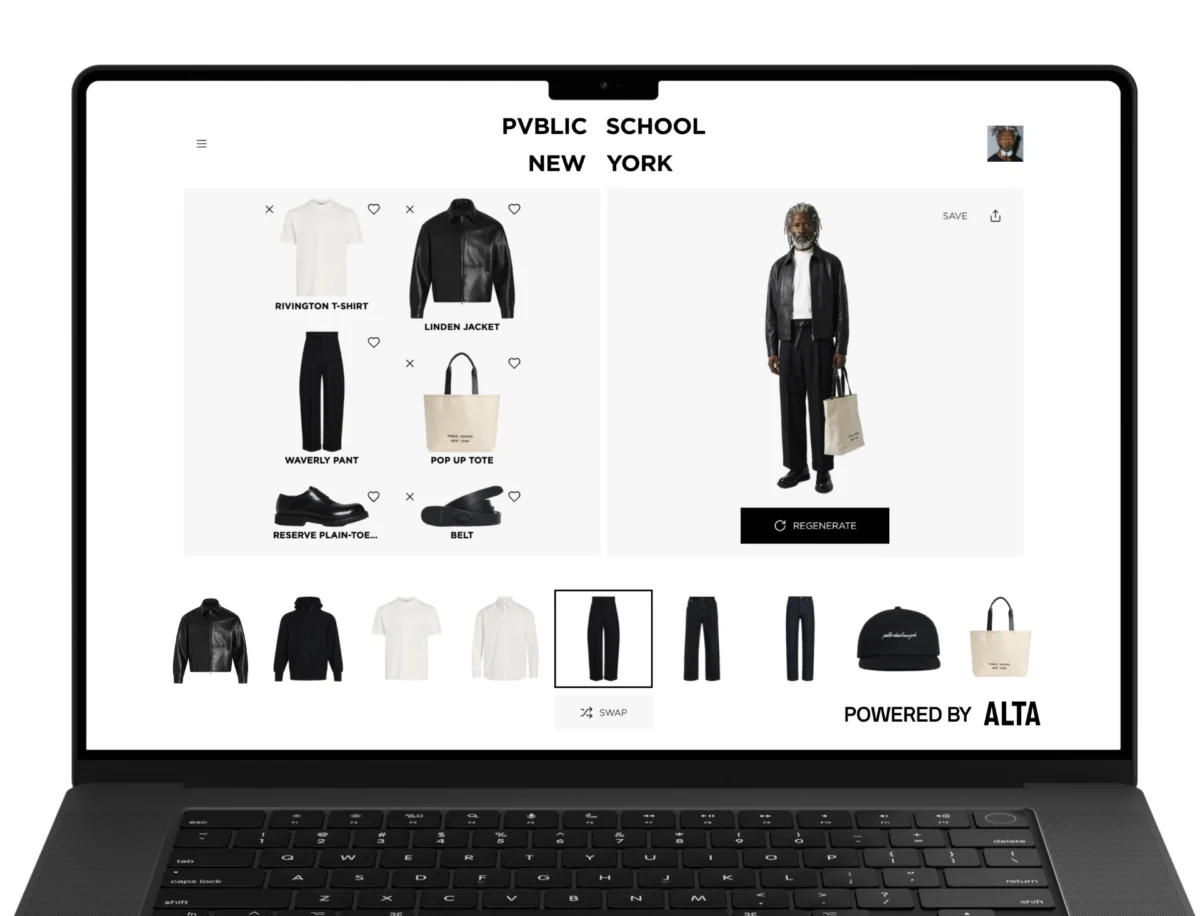
This enterprise strategy achieved a major milestone during New York Fashion Week (NYFW) with the announcement of Alta’s inaugural brand integration partnership: a collaboration with Public School New York, the renowned contemporary menswear and womenswear label co-founded by designers Dao-Yi Chow and Maxwell Osborne.
The partnership materialized through mutual industry connections, catalyzed by the founder of Poshmark, who serves as an angel investor in both Alta and Public School. Recognizing the potential of virtual try-on technology, Chow and Osborne sought an innovative AI partner to enhance their digital storefront ahead of the brand’s much-anticipated return to the fashion calendar. Public School had previously gone on hiatus for several years, using the pause to reevaluate its creative identity and operational ethos. The brand’s grand re-debut at NYFW signalized a revitalized commitment to modern storytelling and technological integration.
Through this new collaboration, shoppers browsing the Public School website can access a "Style with Alta" button embedded directly on product pages. Clicking the icon redirects the consumer to Alta’s ecosystem, where they can instantly view how specific pieces from the new collection fit and drape on their personalized virtual avatar before making a purchasing decision.

Chronology of Technological Evolution in Retail
The convergence of artificial intelligence and fashion e-commerce represents the latest phase in a long-standing technological evolution within the retail sector. Understanding Alta’s market position requires examining the broader timeline of digital adoption within the apparel industry:
- Early 2010s: E-commerce largely relied on static two-dimensional product photography and basic sizing charts, resulting in high return rates due to improper fit.
- Late 2010s: Major luxury and fast-fashion houses, including Balmain and Zara, began experimenting with rudimentary digital avatars and computer-generated marketing campaigns. However, these early iterations were computationally heavy, slow to render, and limited in the number of garments they could layer simultaneously.
- 2023: Alta officially launches its consumer application, introducing advanced AI-driven digital closets and customizable virtual avatars inspired by cinematic concepts.
- 2024: Alta secures $11 million in venture backing led by Menlo Ventures, enabling the expansion of its platform and securing critical industry partnerships with Poshmark and the CFDA.
- Present Day: The company transitions into enterprise integration, launching its debut web-embedded try-on collaboration with Public School New York during New York Fashion Week, thereby bridging the gap between standalone consumer apps and native brand websites.
Industry Implications and Technical Superiority
As virtual try-on solutions become increasingly prevalent, software performance and user experience remain critical differentiators in a competitive marketplace. Established fast-fashion giants like Zara have previously introduced digital dressing room features, yet technological bottlenecks often hinder widespread consumer adoption. According to comparative data highlighted by company leadership, traditional retail avatars often struggle with layering complexity, frequently restricting users to a maximum of four garments while requiring processing times of approximately two minutes per session.
In contrast, Alta’s proprietary rendering engine allows avatars to layer eight or more distinct items within a matter of seconds. This technical efficiency is critical for maintaining consumer engagement in fast-paced digital shopping environments, where high latency frequently leads to cart abandonment.
From the perspective of brand leadership, the integration of AI is no longer viewed merely as a novelty, but as a fundamental pillar of modern consumer engagement. Reflecting on the partnership with Alta, Dao-Yi Chow emphasized the necessity of treating technology as an active business partner rather than a superficial design gimmick.
"It’s not 2015 anymore," Chow noted in an interview during New York Fashion Week, underscoring the evolution of digital retail strategies. He emphasized that the brand’s objective is to deploy AI thoughtfully to extend narrative storytelling and enable consumers to experience the collection intimately, even if they are unable to attend physical runway shows or visit brick-and-mortar storefronts in person.
The Future of Agentic Commerce and Personal Identity
Looking forward, Alta’s leadership envisions a dual-pronged business model. The consumer-facing application will continue to function as the modern digital closet, while the enterprise tier will provide seamless, cross-platform virtual try-on experiences embedded directly within third-party retail websites. Currently, consumers utilizing standard e-commerce sites outside of the Alta network must manually add potential purchases to an external wishlist within the Alta app. The overarching corporate objective is to eliminate this friction entirely, enabling universal, instantaneous virtual try-ons across the entirety of the internet.
Beyond immediate retail applications, Wang characterizes Alta’s long-term strategic vision as establishing the foundational "personal identity layer" for the future of consumer artificial intelligence and e-commerce. As the technology sector shifts toward agentic commerce—autonomous AI systems capable of executing transactions and managing consumer tasks on behalf of users—the availability of structured, highly accurate personal data becomes paramount.
For agentic commerce to operate effectively in the apparel sector, AI shopping agents require access to a secure, comprehensive data repository that encapsulates individual stylistic preferences, historical purchase data, and precise anatomical likenesses. By positioning its virtual avatars and digital closets as this necessary data infrastructure, Alta aims to transition from a niche styling application into an essential utility powering the next generation of digital retail.