









Independent cinema has long prided itself on challenging societal boundaries, inviting audiences to grapple with uncomfortable moral questions that mainstream studios routinely avoid. In his audacious second feature, Blue Film, 26-year-old director Elliot Tuttle constructs a claustrophobic, high-tension psychological thriller that operates entirely within this perilous territory. Eschewing traditional narrative comforts, the film plays out almost exclusively inside a rented Los Angeles living room over the course of a single, dialogue-heavy night. Reminiscent of Richard Linklater’s Before Sunrise in its structural reliance on continuous, winding conversations between two men, Blue Film subverts romantic convention entirely. Instead, it pairs a sex-positive gay camboy with a convicted sex offender who secretly harbored an illicit attraction to him during his childhood.
As the film prepares for its United Kingdom theatrical release on September 11, it has already begun generating intense discourse across the international film festival circuit. Garnering attention for its fearless willingness to probe the architecture of deviance, isolation, and power dynamics, Tuttle’s low-budget project relies not on graphic depictions of explicit acts, but on the volatile weight of its intellectual and psychological confrontations. By weaponizing conversation and subverting expectations of screen violence and nudity, Blue Film positions itself as a daring exploration of human frailty, accountability, and the dark recesses of misplaced affection.
Main Facts and Narrative Premise
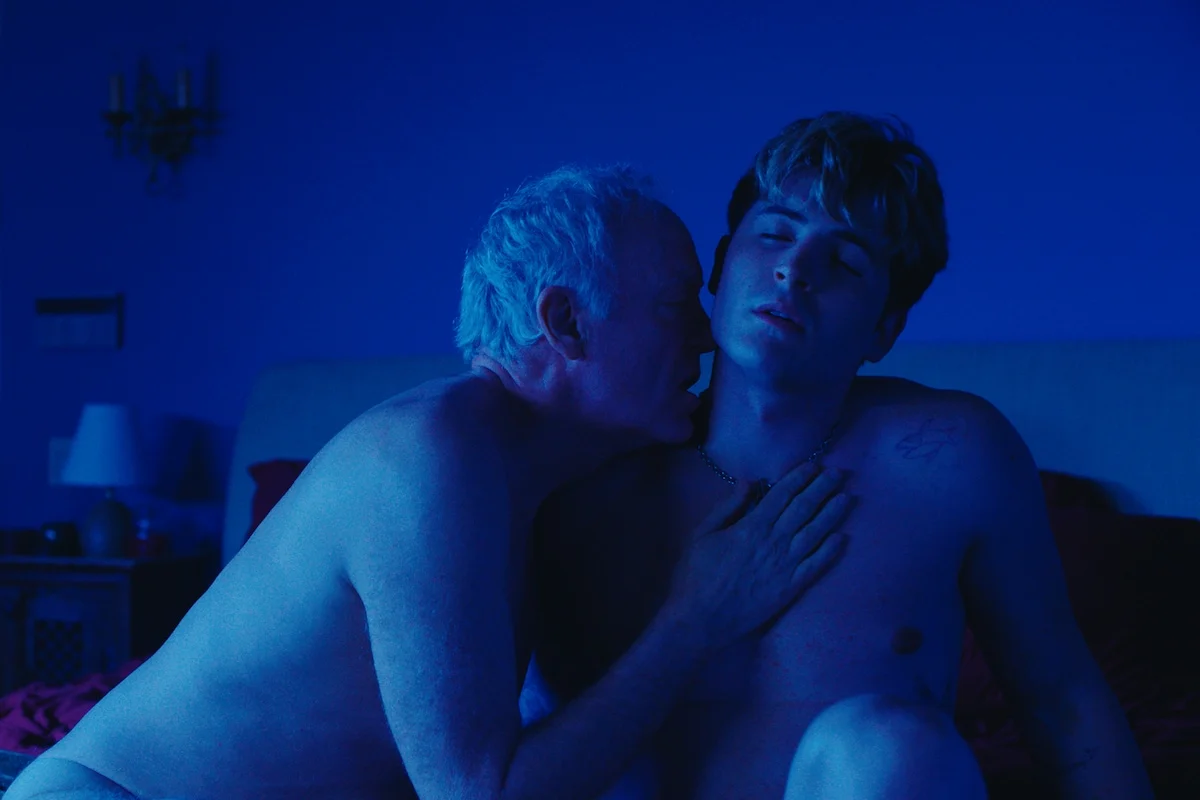
The narrative centers on Aaron, played with a complex blend of bravado and underlying vulnerability by Kieron Moore. Aaron is a successful camboy who frequently capitalizes on financial domination (findom) and physical exhibitionism to monetize his imposing, tattooed physique. Believing he has secured a lucrative transaction, Aaron accepts a $50,000 offer from an anonymous client to spend a single night at a private residence in Los Angeles.
Upon arrival, Aaron is greeted by an older man wearing a mask—an anonymity that initially mimics the digital barriers of his online webcam work. However, the veneer shatters when the mask comes off, revealing the client to be Hank Grant, portrayed with haunting depth by Reed Birney. Grant is Aaron’s former high school English teacher, a man who was previously arrested and imprisoned for attempting to engage in illicit acts with a minor pupil.
What follows is an escalating psychological chess match set against the backdrop of pizza, beer, and forced nostalgia. Aaron, initially confident in his ability to compartmentalize his sex work and maintain transactional control, rapidly crumbles as Hank’s unsettlingly specific roleplay requests come to light. The interaction forces Aaron to reconsider the boundaries of his profession, his safety, and his own past. Despite deep-seated personal disgust, Aaron finds himself reluctant to leave the locked house. The dynamic shifts further when Aaron permits Hank to shave his head, a symbolic and physically disorienting act that seems designed to artificially regress Aaron’s appearance back to his youth.
Chronology and Genesis of the Project
The conceptual foundation of Blue Film traces back three years prior to principal photography, when director Elliot Tuttle was residing in Los Angeles. During that period, Tuttle began keeping journals reflecting on his own adolescent memories and adolescent crushes on authority figures.
Speaking via video call from his home in New York, Tuttle elaborates on the psychological retrospective that inspired the script. He notes that he was heavily consuming the provocative films of French auteur Catherine Breillat at the time, leading him to re-examine his early formative sexuality. Tuttle observed that an adolescent brain lacks the neurological maturity to morally qualify or contextualize certain attractions. Looking back as an adult, he began to question the nature of those desires, ultimately channeling those inquiries into a broader thematic study on profound loneliness.
Tuttle’s creative process was also informed by anecdotal accounts from acquaintances who had engaged in romantic or sexual trysts with former educators after graduating. These parallel real-world dynamics lent the screenplay a grim plausibility, steering it away from pure abstraction and grounding it in unsettlingly familiar human behaviors. Working with an exceptionally tight budget of just $50,000, Tuttle engineered a production schedule that prioritized tight spatial confinement, dialogue-driven tension, and meticulous character work over extensive set pieces.
Supporting Data and Research Methodology
Writing a screenplay involving a convicted sex offender presents immediate ethical and artistic perils, most notably the risk of inadvertently generating sympathy for a perpetrator of abuse. Tuttle was acutely aware of this tightrope walk during the drafting phase.
To ensure authenticity without relying on trope-heavy villainy, Tuttle engaged in extensive research. He acknowledged the inherent paradox of his position, noting that while he is a gay man, he is neither a sex worker nor a sex offender. Consequently, he sought to understand the minute behavioral patterns of individuals convicted of such crimes—observing how a man like Hank moves through a physical space, the cadence of his speech, and the psychological justifications he constructs.
Among the documentary resources utilized during pre-production, Tuttle highlighted the 2014 documentary Pervert Park as profoundly influential. The documentary follows a community of registered sex offenders living together in Florida following their release from prison, detailing their struggles with accountability and reintegration. A consistent narrative thread across the documentary subjects, and across Tuttle’s broader research, was the revelation that many convicted sex offenders were themselves victims of childhood abuse. This cycle of trauma frequently results in a severely warped comprehension of affection, intimacy, and boundaries.
Tuttle has consistently maintained that these sociological findings are not intended to serve as a legal or moral justification for the crime of paedophilia. Rather, the research provided a foundation to explore how an individual might arrive at such a state of moral decay, addressing a subject where institutional academic funding for research remains scarce.
Power Dynamics, Character Analysis, and Societal Taboos
The core tension of Blue Film is sustained by its volatile, ever-shifting power dynamics, which hold up a mirror to contemporary societal anxieties surrounding consent, punishment, and physical vulnerability.
The narrative constantly forces the audience to re-evaluate who holds the upper hand. Hank is a frail, aging, and unemployable social pariah who has already served a prison sentence for his crimes, raising the ethical question of the extent to which an individual should face perpetual societal ostracization after serving their legal debt. Conversely, Aaron is a physically imposing, young, and fit adult working within a consensual digital sex economy. Yet, once trapped inside a locked domestic space with an erratic older man, the physical and psychological safety parameters invert.
The performances of the two lead actors anchor this precarious tightrope. Reed Birney portrays Hank not as a mustache-twirling caricature, but as a tragic, isolated soul completely consumed by his own monstrous actions and psychological ruination. In opposition, Kieron Moore strips away Aaron’s muscular bravura to expose a deeply fractured individual grappling with past trauma and the unexpected collapse of his professional boundaries.
Critically, despite the film’s controversial thematic reputation, Blue Film features a distinct absence of physical nudity. Tuttle deliberately chose to restrict the provocation to the intellectual and verbal realm, recognizing that explicit visual depictions would merely act as a superfluous distraction from the psychological warfare unfolding on screen.
Broader Impact, Audience Reception, and Critical Implications
Since its initial festival screenings, Blue Film has proven to be a polarizing litmus test for audiences, eliciting vastly divergent reactions. Viewers have reported extreme dichotomy in theater environments, ranging from dead, suffocating silence to vocal, highly agitated reactions. Tuttle has expressed satisfaction with this varied reception, noting that he intentionally engineered the film to establish an individualized relationship with every spectator, challenging them to meet the material on their own terms.
From an industry perspective, the film represents a growing appetite within independent cinema for micro-budgeted features that utilize restricted settings to explore severe ethical breaches. By refusing to adopt a heavy-handed moralizing tone, Tuttle leaves audiences without the comfort of easy narrative resolution. Instead, the film trusts the viewer to hold the unequivocal truth that the acts described are criminal and immoral, allowing the narrative to delve unflinchingly into the psychological underpinnings of isolation, trauma, and the dark architecture of human desire.
As Blue Film transitions to commercial cinemas across the United Kingdom this September, it remains to be seen how mainstream audiences will receive its incendiary premise. However, its success in sparking rigorous debate about the boundaries of art, the ethics of representation, and the complexities of human trauma is already assured. Tuttle’s bold feature stands as a testament to the power of independent filmmaking to confront the darkest corners of human experience without blinking.