









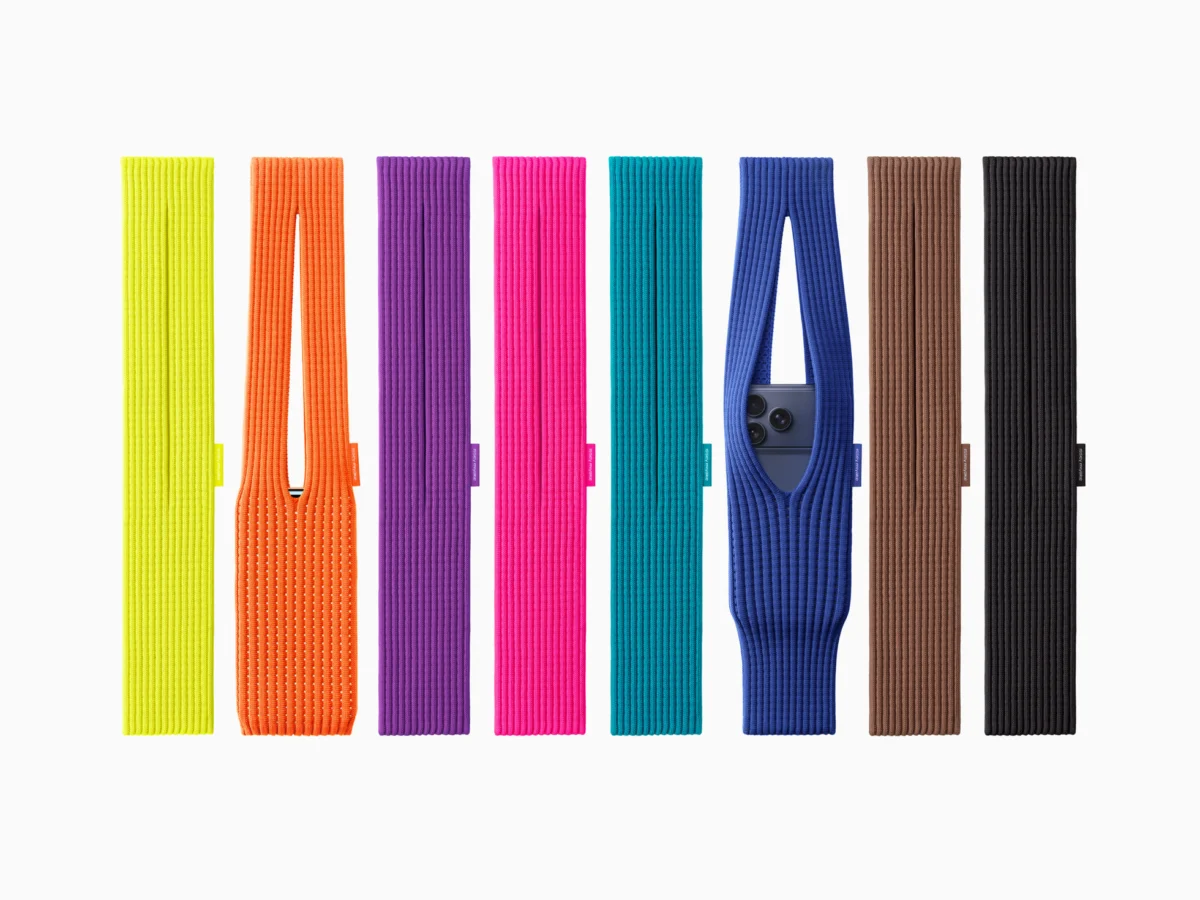
Apple Inc. has expanded its portfolio of premium accessories through a high-profile collaboration with the legendary Japanese design house Issey Miyake, unveiling a limited-edition "iPhone Pocket." The product, which draws inspiration from avant-garde textile engineering, represents a significant intersection between consumer technology and high fashion. Retailing at $149.95 for the "short" model and $229.95 for the "long" crossbody version, the iPhone Pocket is positioned as a luxury lifestyle product rather than a traditional protective case. The accessory is constructed from a single piece of proprietary fabric, utilizing a design philosophy that minimizes waste while maximizing structural integrity through advanced knitting techniques.
A Convergence of Silicon Valley Utility and Japanese Avant-Garde
The iPhone Pocket is not merely a fabric sleeve; it is an application of the "A-POC" (A Piece Of Cloth) concept, a revolutionary manufacturing process pioneered by the late Issey Miyake in 1997. According to product specifications released by Apple, the accessory features a ribbed mesh structure that mimics the signature pleats for which the Miyake brand is globally renowned. The textile is engineered to be highly elastic, allowing it to conform to the shape of the iPhone while maintaining its structural memory.
A unique functional aspect of the iPhone Pocket is its semi-transparency when under tension. Apple’s marketing materials note that when the fabric is stretched by the insertion of the device, the open textile subtly reveals the contents, allowing users to view notifications or check the time on the iPhone display without removing the phone from the pocket. This "peek" functionality bridges the gap between a concealed carry and an accessible interface. The product is available in a variety of vibrant hues, including a "Short Lemon" variant that has already garnered significant attention from fashion commentators.
The Technical Heritage of APOC: A Piece of Cloth
To understand the significance of the iPhone Pocket, one must look at the technological innovations of the Issey Miyake brand. The APOC system, developed by Miyake and his associate Dai Fujiwara, utilizes computer-programmed knitting machines that create garments from a single, continuous tube of fabric. This method is celebrated in the design world for its efficiency and its departure from the traditional "cut-and-sew" manufacturing model, which often results in significant textile waste.
By adopting this concept for an iPhone accessory, Apple is aligning its brand with the history of industrial design and sustainable fashion. The iPhone Pocket’s mesh structure is designed to be lightweight yet durable, providing a tactile experience that differs sharply from the silicone and leather (or FineWoven) materials typically associated with smartphone protection. While the late Issey Miyake passed away in 2022, his design studio continues to operate under his foundational principles, ensuring that this collaboration remains faithful to his vision of "tech-forward" fashion.
A Historical Connection: The Jobs-Miyake Uniform
The partnership between Apple and the Miyake label is rooted in a decades-old relationship between two of the 20th century’s most influential figures: Steve Jobs and Issey Miyake. In the early 1980s, during a visit to Sony’s headquarters in Japan, Jobs was impressed by the company’s employee uniforms, which were designed by Miyake. Jobs initially attempted to implement a similar uniform policy at Apple, but the idea was met with resistance from employees.

Despite the setback at the corporate level, Jobs’ personal admiration for Miyake’s aesthetic led to a unique personal collaboration. Jobs commissioned Miyake to design a personal uniform that would simplify his daily routine and create a consistent brand image. Miyake famously provided Jobs with approximately 100 copies of a black mockneck sweater. This garment became the centerpiece of Jobs’ iconic "Silicon Valley uniform," consisting of the black mockneck, Levi’s 501 jeans, and New Balance sneakers. This historical context provides a deep narrative layer to the current iPhone Pocket release, marking the first time the two brands have officially collaborated on a consumer-facing product.
Market Trends: The Rise of the "Accessory for Accessories"
The launch of the iPhone Pocket occurs within a broader cultural shift where consumers are increasingly investing in "accessories for their accessories." Industry analysts point to several concurrent trends that suggest a growing market for high-priced, niche tech add-ons.
- The Labubu Phenomenon: The "blind box" toy craze, led by characters like Pop Mart’s Labubu, has demonstrated that consumers are willing to pay significant premiums for decorative items that attach to bags or phones. While a standard Labubu keychain may retail for $30, rare editions have reached secondary market prices exceeding $10,000.
- The Stanley Cup Economy: The trend of "accessorizing" the Stanley Quencher—using "water bottle boots," snack bowls, and tiny charms—shows that utility-focused products are being reimagined as canvases for personal expression.
- Miniature Bag Culture: Brands ranging from luxury houses like Telfar to mainstream retailers like IKEA and Trader Joe’s have seen massive success with "mini" versions of their signature bags, often used solely to hold a phone or a pair of earbuds.
Apple’s iPhone Pocket enters this ecosystem as a high-status entry. The "Short" version is designed to be tied to larger handbags, acting as a decorative yet functional extension of a primary bag. The "Long" version addresses the growing demand for crossbody phone straps, a category Apple recently entered with its own $59 branded strap.
Pricing Strategy and Consumer Demographics
The pricing of the iPhone Pocket—$149.95 for the short version and $229.95 for the long version—has sparked debate among tech enthusiasts. Critics argue that the price is exorbitant for a fabric sleeve, drawing comparisons to Apple’s $19 Polishing Cloth, which was widely parodied upon its release in 2021 despite becoming a consistent best-seller.
However, from a luxury fashion perspective, the pricing is relatively conservative. Issey Miyake’s "Pleats Please" accessories and APOC-based garments often retail for several hundred to several thousand dollars. By positioning the iPhone Pocket at the $150–$230 price point, Apple is targeting a specific demographic: the "aspirational luxury" consumer. This consumer base values brand heritage and design pedigree over pure utility. The limited-edition nature of the product further enhances its appeal as a collectible item, potentially insulating it from traditional value-for-money criticisms.
Comparative Analysis: Apple’s Accessory Ecosystem
The iPhone Pocket represents a pivot in Apple’s accessory strategy. In recent years, the company has faced challenges with its in-house materials, most notably the "FineWoven" line introduced to replace leather. FineWoven was met with mixed reviews regarding its durability and resistance to scratches. By collaborating with an established fashion house like Issey Miyake, Apple can leverage external expertise in textiles to offer a premium alternative that carries its own prestige.
When compared to other luxury tech collaborations—such as the Apple Watch Hermès, which can cost upwards of $1,250—the iPhone Pocket is a more accessible entry point into the "luxury tech" space. It allows Apple to maintain its status as a tastemaker in the design world while catering to the growing trend of "phone-only" travel. As more consumers rely on Tap to Pay and digital keys, the need for a traditional wallet or large handbag diminishes, making a specialized phone sling like the iPhone Pocket a logical evolution of the modern carry.

Environmental and Design Implications
One of the most significant aspects of the iPhone Pocket is its alignment with modern sustainability goals. Issey Miyake’s APOC process is celebrated for its near-zero-waste output. Because the fabric is knitted to the exact dimensions required for the product, there are no offcuts or scraps typically found in garment production.
Apple has committed to becoming carbon neutral across its entire business, including its products, by 2030. While the company has not released specific environmental impact data for the iPhone Pocket, the use of Miyake’s efficient manufacturing techniques suggests a move toward more responsible production in its luxury line. The "ribbed mesh" design also provides a form of natural protection; the air-filled gaps in the knit act as a cushion, providing a degree of shock absorption that traditional flat fabrics cannot offer.
Broader Impact and Market Outlook
The iPhone Pocket by Issey Miyake is likely to serve as a bellwether for future Apple collaborations. If successful, it could pave the way for more partnerships with specialized design houses, moving Apple further into the territory of a lifestyle and fashion brand.
Industry analysts expect the "Short" version of the pocket to be the more popular of the two sizes, particularly as a gift item for the holiday season. Its versatility as a bag attachment makes it an easy addition to existing fashion ensembles. While the high price point remains a barrier for the average consumer, the product is expected to sell out quickly among "collectors of the brand" and fashion enthusiasts who appreciate the Jobs-Miyake historical connection.
In conclusion, the iPhone Pocket is more than a simple phone case; it is a tribute to a historical friendship, a showcase of advanced textile engineering, and a strategic move into the lucrative "accessory for accessories" market. Whether it becomes a mainstay of the Apple ecosystem or remains a niche collector’s item, it underscores Apple’s continued dominance in defining the intersection of technology, culture, and high design.