






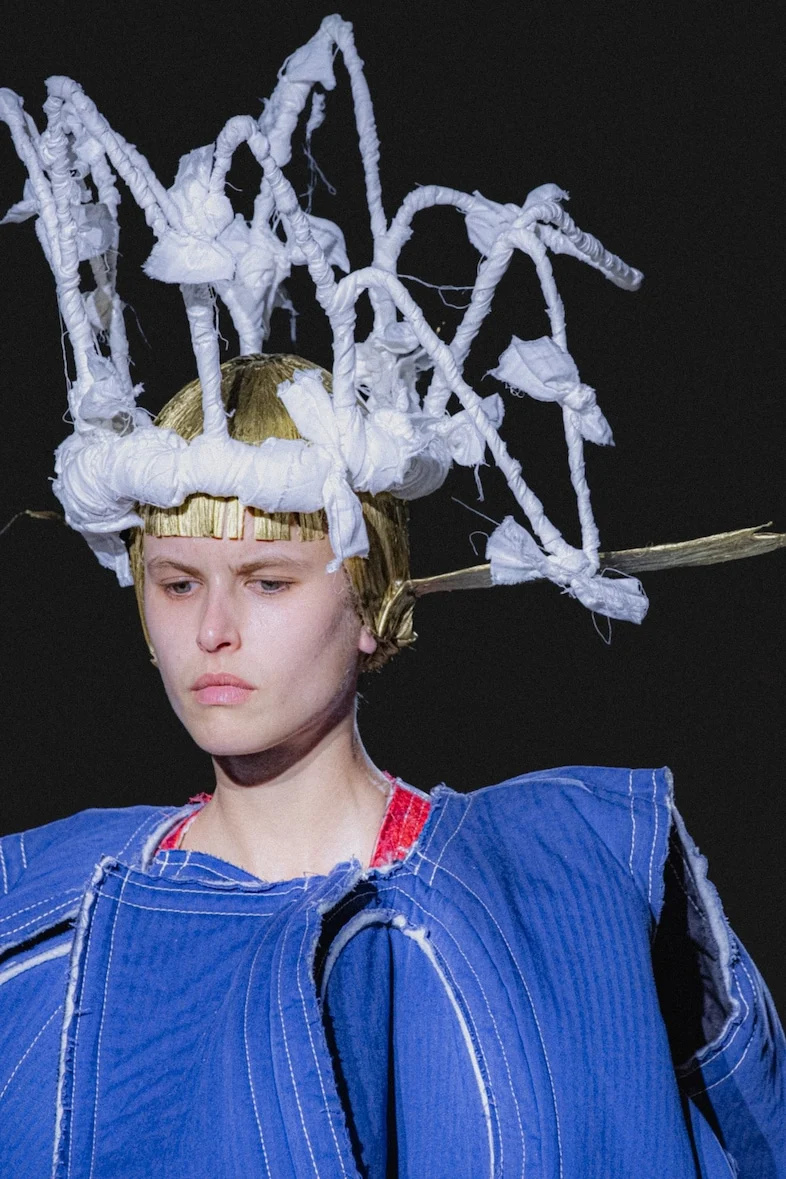
The shifting topography of contemporary fashion rarely adheres to predictable trajectories, yet few design houses command the perceptual whiplash executed by Rei Kawakubo’s Comme des Garçons. Following a season defined by a rigorous, defiant exploration of the color black—which Kawakubo famously characterized as the hue of resistance, justice, and independence—the legendary Japanese label returned to the Paris runway for its Spring/Summer 2027 presentation with an explosion of high-chroma primary colors, sculptural dissonance, and avant-garde royal satire. Staged during the bustling calendar of Paris Fashion Week, the collection dismantled traditional hierarchies of opulence, transforming everyday utility fabrics into towering, theatrical testaments to human imagination.
The runway presentation immediately signaled a stark departure from the somber introspection of the preceding Autumn/Winter collection. Where Kawakubo once relied on twenty distinct variations of black silhouettes to articulate her artistic manifesto, the Spring/Summer 2027 runway vibrated with crimson polka dots, piercing cobalt blues, faded earthy greens, and aggressively rich mustard yellows. This chromatic pivot was accompanied by Kawakubo’s characteristic brevity: a cryptic, single-sentence show note that read, “When royal life and everyday life become one.” This philosophical premise laid the groundwork for an exhaustive deconstruction of class, costume, and the very mechanics of garment construction.
The Chronology of Kawakubo’s Creative Pivot: From Monochrome Defiance to Chromatic Subversion
To fully grasp the magnitude of the Comme des Garçons Spring/Summer 2027 collection, one must examine the rapid ideological evolution that Kawakubo has undertaken over consecutive fashion cycles. The trajectory of the brand over the past year highlights a deliberate oscillation between absolute minimalism and maximalist sculptural anarchy.
During the Autumn/Winter presentation cycle, Kawakubo’s show notes arrived as a sparse, elusive declaration. The designer noted her renewed affinity for the absence of color, explaining that after decades of conceptual experimentation, black remained the ultimate vehicle for her creative ethos. In a subsequent cover interview with Dazed, Kawakubo expanded on this thematic foundation, stating that black is an essential color for her artistic expression because it embodies resistance, justice, and independence. The resulting collection comprised twenty meticulously tailored black looks that prioritized architectural austerity over surface ornamentation.
However, fashion is inherently reactive, and Kawakubo’s creative philosophy thrives on paradox. By the time the industry converged on Paris for the Spring/Summer collections, the austere gloom of the previous season was entirely replaced by an exuberant reclamation of color. This abrupt transition underscores Kawakubo’s aversion to stagnation. Rather than refining a singular aesthetic indefinitely, the designer utilized the chromatic spectrum to challenge her audience once again, proving that color, when handled with avant-garde severity, can be just as disruptive as total darkness.
Deconstructing the Runway: Royal Satire and Avant-Garde Proportions
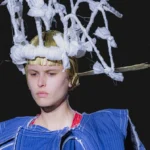
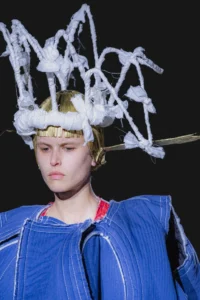
The runway itself was a masterclass in conceptual juxtaposition, wedding the iconography of monarchy with the mundane realities of the working class. True to the show’s conceptual premise, the looks were heavily accented with tall, crown-like headpieces meticulously engineered by milliner Nobuki Hizume. These regal toppers, which grazed the ceiling of the venue, immediately established a satirical dialogue surrounding power, status, and authority.
Yet, the garments situated beneath these majestic crowns were deliberately earthy, rough-cut, and irreverent. Kawakubo utilized rough-cut denim shaped into radical, avant-garde proportions, effectively stripping America’s most utilitarian fabric of its traditional associations. Plasticky brocade peeked out from underneath pieced-together jackets, creating an unsettling visual tension between cheap synthetic materials and historically rich jacquards. Furthermore, classic pinstripes—typically reserved for the conservative boardrooms of global finance—were puffed up into pillow-like separates, successfully unravelling any conventional understanding of royal or professional dressing.
Beyond fabric experimentation, the collection actively reshaped the human anatomy, continuing Kawakubo’s lifelong investigation into bodily distortion. Hair splayed out dramatically from behind rigid tubular gowns, creating an eerie, spectral silhouette. In other instances, fabric was aggressively scrunched behind oversized, exaggerated ribcages, forcing viewers to question the natural contours of the torso. Dresses morphed the models’ silhouettes into literal musical instruments, specifically guitar and violin shapes that challenged traditional tailoring constraints. Meanwhile, clear corsets were deployed to elongate and hunch the shoulders, creating an unsettling posture that inverted centuries of European corsetry designed to enforce upright elegance.
Industry Context and the Therapeutic Function of Fashion
As is customary with Comme des Garçons, the deeper philosophical implications of the collection were left open to interpretation, inviting art critics, buyers, and consumers to project their own narratives onto the garments. In an industry increasingly dominated by commercial predictability and algorithmic trend forecasting, Kawakubo’s refusal to provide a definitive manual for her work remains a refreshing act of defiance.
Despite the complex, often intimidating nature of the garments, the atmosphere within the venue was remarkably joyous. Attendees capturing video footage of the presentation frequently panned to reveal members of the fashion crowd smiling—a rare display of visible delight in an industry often characterized by detached cynicism. This emotional resonance may very well be the central thesis of Kawakubo’s current creative chapter.
Addressing the broader sociopolitical climate and the heavy, often hopeless realities of the modern world, Kawakubo offered a rare glimpse into her design philosophy during her aforementioned interview. When asked about the capacity of fashion to impact dark times, the designer articulated a profoundly humanist perspective.
“I believe the role of fashion is that, by expressing oneself through what one wears, one’s spirits are lifted,” Kawakubo explained. “In other words, [fashion] has a positive effect.”
This perspective reframes avant-garde clothing not merely as esoteric intellectual exercise, but as a vital psychological tool. In an era marked by geopolitical instability, economic anxiety, and cultural polarization, Kawakubo’s Spring/Summer 2027 collection serves as an antidote to despair. By fusing the unreachable majesty of royal life with the tactile familiarity of everyday materials, Comme des Garçons delivers a powerful reminder that self-expression remains one of the few remaining domains of absolute human freedom.
Broader Implications and Future Market Impact
The commercial and cultural ripple effects of the Comme des Garçons Spring/Summer 2027 collection will likely reverberate across the global retail and design landscape for seasons to come. While avant-garde runways frequently showcase wearable art that never translates directly to the commercial floor, Kawakubo’s influence on structural tailoring, denim reinvention, and accessory design consistently dictates mainstream trends with a subtle delay.
Retail analysts note that the juxtaposition of high and low materials—such as rough-cut denim paired with synthetic brocade—aligns with a growing consumer fatigue toward traditional luxury markers. As younger demographics increasingly prioritize irony, deconstruction, and individuality over overt displays of wealth, Kawakubo’s royal satire feels remarkably prescient. By mocking the trappings of monarchy while simultaneously elevating them through exquisite craftsmanship, Comme des Garçons continues to challenge the definitions of luxury, taste, and desirability.
Ultimately, the Spring/Summer 2027 showcase in Paris cements Rei Kawakubo’s status as fashion’s most enduring visionary. Whether cloaking her audience in the protective armor of black resistance or showering them in the vibrant, disruptive hues of a royal-meets-everyday satire, Kawakubo proves that fashion remains a formidable vehicle for intellectual inquiry and emotional elevation. As the industry parses the myriad interpretations of the designer’s latest runway statement, one truth remains undeniably clear: Comme des Garçons continues to write its own rules, entirely unburdened by the expectations of the past.