











The release of Sulfur Surfer, the eighth solo album from Drain Gang figurehead Bladee, has ignited fervent discussion within the experimental music community, marking a significant departure even for an artist renowned for his maximalist, lore-steeped releases. Unveiled as the successor to the critically acclaimed 2024 album Cold Visions, Sulfur Surfer eschews the more accessible hooks of earlier tracks like "I Don’t Like People feat. Yung Lean" in favor of an intensely dense, narrative-driven experience. This shift has positioned the album not merely as a collection of songs, but as a complex tapestry woven from disparate mythologies, personal introspection, and profound philosophical inquiry.
The Sonic Architecture: Whitearmor’s Vision
At the heart of Sulfur Surfer‘s distinctive soundscape is the singular production of fellow Drain Gang member Whitearmor. Known for his ethereal and often melancholic sonic palettes, Whitearmor here steers Bladee’s EDM-rap spectrum firmly into its electronic frontiers. The album is characterized by an immersive blend of kaleidoscopic synths that swirl and refract, apocalyptic bass pumps that anchor the tracks with a visceral weight, and occasionally, stuttering trap kicks that punctuate the rhythmic flow. This intricate sound design creates an atmosphere that is at once expansive and claustrophobic, mirroring the complex internal and external worlds Bladee explores lyrically. The decision to feature Whitearmor as the sole producer underscores a cohesive artistic vision, allowing for a seamless integration of sound and narrative across the album’s 46-minute runtime. This focused collaboration deviates from the more varied production credits seen on some of Bladee’s previous works, suggesting a deliberate effort to craft a unified, almost cinematic, experience.
World-Building as the Primary Art Form
More than a collection of songs, Sulfur Surfer functions primarily as an exercise in world-building. Its narrative density is amplified by its sparse guest features, with only one collaboration across the entire project: an appearance by David Tibet, frontman of the English doom folk band Current93. This choice is telling, as Current93 stands as one of the few groups whose esoteric mysticism rivals that of Drain Gang, known for their deep dives into occultism, Gnosticism, and spiritual philosophy. The album’s intricate web of references, ranging from J.R.R. Tolkien’s Lord of the Rings and Akira Toriyama’s Dragon Ball Z to Christian mysticism and even Mary Poppins, coalesce into a singular postmodern artwork. Within this unique musical universe, traditional binaries of good and evil, nihilism and hope, and fantasy and reality are deliberately blurred and intertwined, inviting listeners into a challenging yet rewarding interpretive journey.
Key Esoteric References and Thematic Pillars
To fully appreciate the scope of Sulfur Surfer, an understanding of its foundational references is crucial. The album is an intellectual and spiritual labyrinth, demanding active engagement from its audience.
1. The Legend of Saint George: A Modern Reinterpretation
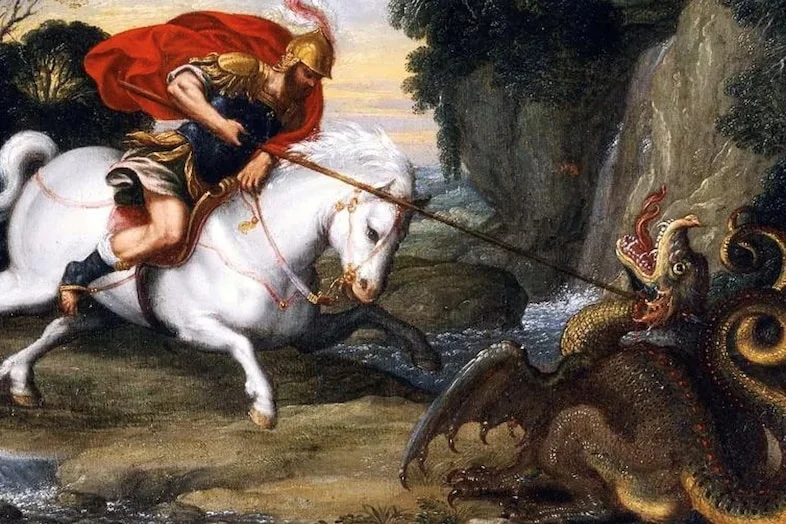
Perhaps the most pervasive allegorical framework on Sulfur Surfer is the ancient legend of Saint George and the Dragon. Bladee first hinted at this thematic direction in a 2025 Pitchfork cover story, where he discussed an upcoming collaboration with Whitearmor: "I don’t want to jinx it, but it’s something with Saint George — I’m trying to use Saint George to make some music […] he’s the one killing the dragon." This foreshadowing materialized not only in the subsequent EP, STE The Beautiful Martyr 1st Attempt, but profoundly throughout Sulfur Surfer. Bladee explicitly adopts the mantle of "Saint George" in the track "Highland Tyrant" and frequently alludes to battling a "black dragon."
This ancient narrative serves as a multifaceted allegory within Bladee’s modern context. On one level, the dragon symbolizes internal struggles, particularly those related to mental health and substance abuse, themes prominently explored in his preceding album, Cold Visions. Lyrics from "Versailles Flow" lament the "venom" of the dragon poisoning his mind and declare, "Ste the martyr, always happy in the night," suggesting a triumph over internal darkness. Historically, the dragon in George’s legend has often been interpreted as an embodiment of sin or temptation. However, Bladee extends this allegory beyond the personal, implying an external dimension to this ongoing battle. The "cruel compassion" and "holy Hawaiian mission" mentioned in the album’s press release hint at a spiritual quest for redemption or enlightenment in a world perceived as corrupted, positioning Bladee’s Saint George as a figure navigating both personal demons and broader societal malaise.
2. Christianity and Contemporary Spirituality
Bladee’s engagement with Christian iconography and themes remains one of the most intriguing aspects of his artistic evolution. A 2024 Substack post titled "Is Bladee Christian music?" by writer Alex Mazey posited that these increasing allusions do not necessarily signify a conversion to dogmatic belief but rather align with "a broader cultural movement towards spirituality and eschatological thinking." Mazey argues that in an era marked by widespread anxieties about global instability, environmental degradation, and societal fragmentation, individuals are increasingly turning to religious frameworks—or at least spiritual concepts—for answers, meaning, or even just validation.
Through this lens, Bladee’s invocation of Saint George embodies a search for righteousness and moral clarity in a world that often feels morally ambiguous or outright depraved. The album’s imagery, from "stinking sulfur lakes" to "The Dark Mirror," reflects a commentary on contemporary issues such as the pervasive influence of social media and rampant materialism. As Bladee declares in the album’s title track opener, "Watch as I transcend torment again / after the ultimate trail of the night rides back towards the one that’s in light / Mirrors shattered, illusions illuminated / Ste in the name of David, amen." This is a Christian mysticism stripped of its conventional religious connotations, repurposed by Bladee much like his deployment of pop culture and high fantasy imagery. It is a spiritual lexicon used to articulate a personal journey of purification and transcendence, rather than an endorsement of any specific creed.
3. Lord of the Rings: High Fantasy as Existential Metaphor
Bladee’s discography has frequently drawn from high fantasy, notably sampling Lord of the Rings: The Two Towers on his cult-favorite album 333. With Sulfur Surfer, this influence deepens considerably. The album’s ninth track, "Durins Bane," directly references the formidable Balrog of Morgoth, a demonic entity from Tolkien’s mythology renowned for its climactic confrontation with Gandalf in the Mines of Moria, as depicted in The Fellowship of the Ring.
The track’s lyrics explicitly evoke this iconic battle: "Fucked up the touch down, Balrog whip, I’m pulling up with sick / Balrog whips, I’ll take you to the abyss." Bladee cleverly weaves wordplay between Durin’s Bane’s signature fiery whip and contemporary slang for a car, grounding the epic fantasy in a modern, urban context. This fusion of ancient myth and contemporary idiom is a hallmark of Bladee’s style, allowing him to explore grand themes of struggle, temptation, and the journey through darkness using universally recognizable narratives, even if filtered through his unique, often cryptic, lens. The Balrog, a creature of shadow and flame, can be seen as another manifestation of the "black dragon" or the internal and external forces that threaten to overwhelm the protagonist.
4. Current93: The Alchemy of Esoteric Collaboration
The sole guest appearance on Sulfur Surfer comes from David Tibet, frontman of the English neofolk band Current93. While seemingly an unexpected pairing, this collaboration is, in retrospect, a profound and fitting union. Current93, much like Drain Gang, is steeped in esoteric lore, with roots in the experimental 1980s British art collective Psychic TV and Tibet’s extensive studies in occultism, linguistics, and magic.
Tibet’s contribution, particularly on the track "Fox & Birch," helps contextualize Sulfur Surfer‘s underlying theme of alchemy, frequently referencing the image of sulfur. His presence also reinforces the album’s espousal of a mysticism that transcends conventional moral binaries. On the standout track "Black Fire," Tibet narrates: "Surfing on the yellow lake of black fire, neither good nor evil," a line that encapsulates the album’s embrace of paradox. Throughout the album, both Tibet and Bladee deploy numerous moral oxymorons—"dreammare," "cruel compassion," "violent kindness"—which reflect a sophisticated engagement with duality. This linguistic play suggests an exploration of liminal states and the idea that true understanding often lies beyond simplistic categorization, aligning with alchemical principles of transformation and synthesis. The "black fire" itself could be interpreted as a symbol of transformation, purification, or a source of power that exists beyond conventional ethical judgments.
5. Nihilism and the Path to Self-Created Hope
A crucial philosophical underpinning of Sulfur Surfer is Bladee’s complex relationship with nihilism. In a 2025 interview with the Swedish Herald, when asked if he considered his music nihilistic, Bladee responded unequivocally: "No, I do not agree with that. I think it’s quite hopeful. I do not feel nihilistic." This statement provides essential context for the overarching message of Sulfur Surfer, which, despite its dark imagery, conveys a markedly more positive trajectory (at least for Bladee) than the "wallowing despair" often perceived in Cold Visions.
This intricate interplay between nihilism and hope is particularly prominent on the album’s lead and sole single, "Blondie." In the track, Bladee proclaims: "There is no before, there is no after / There’s only one king, only one master: King Nothing." He frequently refers to himself as "King Nothing." While superficially this might appear to contradict his disavowal of nihilism, this denial of objective meaning can be understood as a foundational step towards a more liberating existential philosophy: one in which individuals are empowered to create their own meaning and values in a world devoid of inherent purpose. Bladee’s subsequent line on the track, "I am the only one who has anything interesting to say," reinforces this notion of radical self-creation and subjective authority.
This line of thought helps to contextualize the endless stream of esoteric references that populate Bladee’s entire discography. As the name of his self-founded label, "Drain Gang," subtly implies, his artistic universe is an "island of trash" – a postmodern assemblage of discarded or recontextualized images, symbols, and narratives drawn from all corners of subjective experience. These elements are repurposed and reconfigured in a continuous act of self-creation. Beneath the layers of emotional trauma and existential angst he has openly shared with his listeners over the years, Bladee ultimately seems to discover a profound sense of hope in the belief that life is what he actively makes of it. This philosophy of radical self-determination, of forging meaning out of the void, resonates deeply with his dedicated fanbase, who often feel like misfits navigating a confusing world. In this sense, Sulfur Surfer is not just an album; it is a manifesto for embracing chaos and finding liberation in the act of personal myth-making, a core tenet of the Drain Gang ethos.
Broader Implications and Artistic Trajectory
Sulfur Surfer solidifies Bladee’s position as a significant figure in contemporary experimental music, pushing the boundaries of genre and lyrical convention. The album’s dense narrative and complex thematic explorations reflect a growing trend in music towards deeply immersive and intellectually stimulating artistic statements. In an era saturated with easily digestible content, Bladee’s commitment to crafting an intricate, challenging, and deeply personal mythology stands as a testament to the enduring power of art to provoke thought and foster community. The album invites repeated listens and collaborative interpretation, strengthening the bonds within the Drain Gang community and cementing Bladee’s legacy as an artist unafraid to explore the profound questions of existence through a uniquely postmodern lens. The album is not just a musical release; it is a cultural artifact, designed to be dissected, discussed, and absorbed into the collective consciousness of its dedicated followers, further cementing the artist’s unique place in the digital age.